Papier Plié04: Shuzo Takiguchi and Shadows, or the Shadow-Image Man
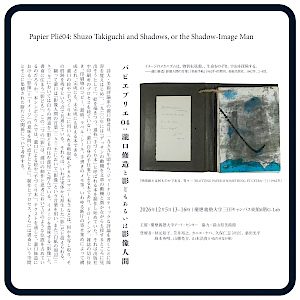
The mechanism of the image penetrates matter, peers into life, and explores the universe.
— Shuzo Takiguchi, “Words of the Shadow-Image Man [Eizo-Ningen no Kotoba],” Bijutsu Techo, April 1962 special issue (Tokyo: Bijutsu Shuppan-sha, 1962), pp. 2–4.
The poet and art critic Shuzo Takiguchi began, around 1959, to “experience difficulties in writing journalistic criticism.” In 1960, seeking “to discover, however faintly, a point of contact between the impulse to draw and the impulse to write,” he began making books commonly referred to as “handmade brochures,” while also producing drawings. These brochures were created entirely by Takiguchi's own hand, without going through the processes of a publishing house or printing press. Composed of assemblages of fragments—including drawings, magazine clippings, copies of printed materials, silver foil, labels, stickers, and handwritten notes—they appear at once finished and unfinished.
Blotting paper and decalcomania (transfer techniques), both employed in Takiguchi's drawings and handmade books, share the characteristic of taking an impression of something and leaving its trace. In this sense, they may be understood as “shadows” derived from a material entity.
Takiguchi, meanwhile, employed the term eizō (影像, image) in “Words of the Shadow-Image Man” (1962), and referred to his own study as “the room inhabited by shadows” in “Around the Blank Page” (1963). The “image” (eizō) and the “shadows” inhabiting his study: what place did these two forms of “shadow” occupy in Takiguchi's artistic practice and thought? Through his drawings, handmade books, and writings, this symposium seeks to reconsider the meaning of eizō (image) in Takiguchi's work, while also examining the relationships between artistic production and process, and between the space of the study and the fragments accumulated within it.
About Papier Plié
Papier plié was a term Takiguchi used to designate works akin to his handmade books. Literally meaning “folded paper,” the term can also refer to paper folding. The entry for “Exquisite Corpse” in the Dictionnaire abrégé du surréalisme (1938) describes it as follows:
“A game of folded paper in which several people compose a sentence or make a drawing.”
André Breton and Paul Éluard, eds., Dictionnaire abrégé du surréalisme (1938); Japanese translation by Jun Ebara, Shururearisumu Kan'yaku Jiten (Tokyo: Gendai Shichōsha, 1976), p. 6 (first Japanese edition, 1971; translation slightly modified with reference to the original).
During the game, what the preceding participant has written or drawn is folded away and concealed, so that the next participant cannot see it.
Please note that the symposium program is subject to change at short notice.
Shuzo Takiguchi Collection
Held by Keio University Art Center
The Shuzo Takiguchi Collection comprises archival materials dating from 1936 to 1979 relating to the poet and art critic Shuzo Takiguchi (1903–1979). Takiguchi began writing experimental poetry in the 1920s. During the 1950s, he engaged in art criticism and organized exhibitions, while in the 1960s he gradually withdrew from critical writing and turned increasingly toward artistic production. He played a central role in shaping the history of postwar art in Japan.
The collection was established in 2001 following the donation of materials by Yo Suzuki, a member of Takiguchi's family. Its principal holdings include correspondence, photographs, printed ephemera relating to events, manuscripts and drafts, handmade books and their constituent materials, and publications.
The collection comprises 6,609 items in total, including:
・Correspondence: 3,538 items
・Manuscripts and drafts: 13 boxes
・Notebooks: 87 items
・Miscellaneous materials: 279 items
・Photographs: 623 items
・Handmade books and their materials: 11 boxes
・Books: 773 items
・Printed ephemera relating to events: 1,323 items
As the units of description differ among archival series, each item or box has been counted as a single unit in the overall total. The extent of archival arrangement and description varies from series to series, and further work is planned for materials whose quantities are currently recorded only at the box level.
Among the surviving materials are objects that would ordinarily have been discarded as waste. Photographs of Takiguchi's study reveal how he repeatedly experimented with rearranging these diverse objects with extraordinary delicacy and care. The collection constitutes an important resource for reconsidering the history of postwar art.
In 2021, the Shuzo Takiguchi Research Group was established to reconstruct an understanding of Takiguchi through the surviving archival materials themselves, while also bringing the continuing relevance of his work into dialogue with the present. Papier Plié serves as the group's public symposium series.
Date
Saturday, December 6, 2026, 1:00–4:00 p.m.
Venue
Keio University (Mita Campus), East Research Building 6F G-LAB.
Campus Map ⑬
Audience
Open to everyone / Come and go anytime
Cost
Free
Enquiries and bookings
Keio University Art Center
2-15-45, Mita, Minato-ku, Tokyo, 108-8345, Japan
TEL +81-(0)3-5427-1621
Date
Saturday, December 6, 2026, 1:00–4:00 p.m.
Venue
〒108-8345 2-15-45, Mita, Minato-ku, Tokyo, Japan Keio University (Mita Campus), East Research Building 6F G-LAB.
Campus Map ⑬
Audience
Open to everyone / Come and go anytime
Cost
Free
Lecturer/Performer
Speakers: Yuko Akimoto, Hiroyuki Kasai, Naha Kanie, Hitoshi Kubo, Kohei Kuwada, Hideaki Shimamoto, Ryosuke Yamakoshi, Hiroki Yamamoto (Inu no Senaka-za)
秋元裕子(あきもと・ゆうこ)
早稲田大学第一文学部文学科日本文学専修卒業。博士(文学・北海学園大学)。専門は日本近代文学。特に、モダニズム・アヴァンギャルド系の芸術・詩・詩論、日本におけるシュールレアリスム受容、瀧口修造研究。直近の論文は、「創造力の外側へ―赤瀬川原平とシュールレアリスム」(『北海学園大学人文論集』第78号、2025年3月)。著書として『瀧口修造研究―〈影像人間の系譜〉』(和泉書院、2022年)。現在、北海学園大学非常勤講師。
久保仁志(くぼ・ひとし)
慶應義塾大学アート・センター・アーキヴィスト。アーカイヴおよび具体的諸資料から出発し、それらが包含する様々な時空間的パースペクティヴを編集(モンタージュ)することで起こった出来事だけでなく起こりえた出来事について考えること、芸術作品における編集の観察・分析・構築を通して人間の経験の諸条件を可変的回路として設計し直す可能性を探求することに関心がある。
島本 英明(しまもと・ひであき)
公益財団法人石橋財団アーティゾン美術館学芸員。フランスを中心とするヨーロッパの20世紀美術を担当。近年担当した主要な展覧会に、「Transformation 越境から生まれるアート」(2022年)、「ブランクーシ 本質を象る」(2024年)、「ゾフィー・トイバー゠アルプとジャン・アルプ」(2025年)、「瀧口修造 書くことと描くこと」(2026年)など。
山腰亮介(やまこし・りょうすけ)
詩人、瀧口修造研究者、公益財団法人絹谷幸二美術財団アーキヴィスト・学芸員。紙一葉による〈詩集〉の制作、詩と芸術の研究、アーカイヴ構築を行う。慶應義塾大学アート・センター主催の展覧会シリーズ「影どもの住む部屋」(瀧口修造展)に特別協力。『現代詩手帖』、『ユリイカ』、『三田文學』、富山県美術館のコレクション展等に瀧口の論考を寄稿。〈詩集〉『めくるめく』(2026)他。批評紙『──の〈余白〉に』主宰。
Timetable
Part 1 | 1:00–2:30 p.m.
Moderator: Hitoshi Kubo
Speakers:
Yuko Akimoto
Hideaki Shimamoto
Ryosuke Yamakoshi
Part 2 | 2:45–4:00 p.m.
Live broadcast from the exhibition gallery at the Toyama Prefectural Museum of Art and Design: Hiromasa Yagi
Participants:
Yuko Akimoto
Hiroyuki Kasai
Naha Kanie
Hitoshi Kubo
Kohei Kuwada
Hideaki Shimamoto
Ryosuke Yamakoshi
Hiroki Yamamoto (Inu no Senaka-za)
Enquiries and bookings
Keio University Art Center
2-15-45, Mita, Minato-ku, Tokyo, 108-8345, Japan
TEL +81-(0)3-5427-1621
Organiser(s)
Organized by Keio University Art Center
With cooperation of Toyama Prefectural Museum of Art and Design
What's on
- SHOW-CASE PROJECT Extra-3 Motohiro Tomii: Conditions of the Figure
- SHOW-CASE project No. 5 Motohiro Tomii: Unit of the Figure
- Shuzo Takiguchi—Double, or Shadow-Image
- Papier Plié04: Shuzo Takiguchi and Shadows, or the Shadow-Image Man
- ダンサー/コレオグラファー山田せつ子による身体ワークショップ「そして なるほど ここにいる」
- Standing Point IV: stanley brouwn