Kasai Akira Post Butoh Performance “Dancing Beethoven The Piano Sonata No. 32 in C minor, Op. 111”
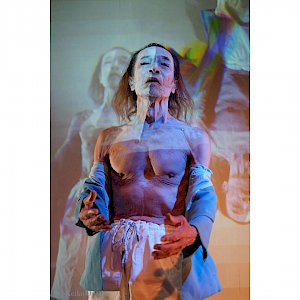
人間のカラダは「音楽の結晶体」である
このベートーヴェンの最後のピアノソナタは
この結晶体を 無限宇宙の果てにまで 解き放つ
©︎Keiko Onoda
Date
Thursday 4 June 2026, 18:00 start (Doors open at 17:30)
Venue
Keio University Hiyoshi Campus, Raiosha Event Terrace
Audience
Open to anyone
*席に限りがありますので、あらかじめご了承ください。
*会場内では、主催者により写真や動画撮影が行われる予定です。出演者の動線に沿って、会場内のお客さまが映り込む場合があります。
Cost
Admission Free
Enquiries and bookings
Keio University Art Center
2-15-45 Mita, Minato-ku, Tokyo, 108-8345
Tel: 03-5427-1621
pj.ca.oiek.c-tra@otomihsi
Performance[Keio University Freshman Event 2026]
Date
Thursday 4 June 2026, 18:00 start (Doors open at 17:30)
Venue
Keio University Hiyoshi Campus, Raiosha
4-1-1 Hiyoshi, Kohoku-ku,Yokohama
Access from Hiyoshi Station(Tokyu Toyoko Line / Tokyu Meguro Line / Tokyu Shin-yokohama Line / Yokohama Municipal Subway Green Line)
Audience
Open to anyone
*席に限りがありますので、あらかじめご了承ください。
*会場内では、主催者により写真や動画撮影が行われる予定です。出演者の動線に沿って、会場内のお客さまが映り込む場合があります。
Cost
Admission Free
Booking
No booking required
Lecturer/Performer
Performance: Kasai Akira
Sound/Lighting: Soga Masaru
[Performer profile]
Kasai Akira was born in Mie Prefecture in 1943. His childhood was marked by the strict discipline of his father Torao, a judge, who he lost to the Toya Maru ferry accident on September 26, 1954. It would be safe to characterize the historical “Resurrection of Jesus” as one of Kasai’s lifelong themes. He entered the world of dance following his studies at the studio of Eguchi Takaya and Miya Misako, and would go on to meet Ohno Kazuo and study directly under him for three years. In October 1963 he encountered Hijikata Tatsumi as a dancer in the Gi-gi (“Sacrifice Ceremony“) at Asahi Hall and would later perform in “A Rose-colored Dance: A LA MAISON DE M. CIVECAWA” at Sennichidani Hall, in November 1965. He established his own studio, the Tenshi-kan (“House of Angels”), in 1971, and lived in Germany from 1979 to 1985. His practice takes in eurhythmy and pantomime, and is not constrained by “butoh” in its narrow sense.
A highly regarded writer, his position of emphasizing mystery and spirituality is expounded in his books Tenshi-ron (“About Angel”), Seirei Butoh (“Spiritual Butoh”), and Tomei Meikyuu (“Crystal Labyrinth”) – a photographic collection produced in collaboration with Eikoh Hosoe – among many other published works. His works cover a broad range of topics from Western occultism through to Oishigori Masumi’s Shinkun Kojiki (“Chronicles of Shinkun”), and sublimates them into “dances” which transcend mere quotidian language, earning him an ardent fan base as an author. Meanwhile, just as he puts it that: “I can hear the music of the heavens” (Spiritual Butoh, p.9), and asserts that “The Holy Spirit is energy, and one cannot live for a single moment without it” (Spiritual Butoh, p.26.), as a dancer he gives his audiences a sense of the cosmic as well as of tradition, transcending Modern Japan through a pre-modern, European, “Dance Cosmology.” He is, in essence, embodying the irresoluble mysteries of the gods found, for example, in the poetry of Sir John Davies, 1569-1626.
As Kasai states at the beginning of The Body and Life: Super Generational Dance: “As long as history is a living entity in the continual process of change, any era is a turning point. Nevertheless, rather than each person living continually across all eras, humans are confined to specific time periods, with their own sense of how the era in which they actually live constitutes a turning point. Such perception will involve marshaling their imaginations to achieve a bird’s eye view of history as a whole.” Such sentiments illustrate Kasai’s strong awareness that modernity and the social are also pivotal to dance. A recipient of the Minister of Education Award for Fine Arts for his 2013 performance “Dancing the Constitution of Japan.”
This is the fifth occasion on which Akira Kasai will perform at the welcome event for Keio University’s incoming students. In 2010, he conducted the poetry and dance session, “Sphere, Flashing Souls: REQUIEM” in a collaboration with Gozo Yoshimasu. He later performed “Dancing the Constitution of Japan” in 2020, “Dancing John the Apostle” in 2021, “Dancing Chopin” in 2022 and "Unfinished" in 2024. (Hayato Kosuge)
Enquiries and bookings
Keio University Art Center
2-15-45 Mita, Minato-ku, Tokyo, 108-8345
Tel: 03-5427-1621
pj.ca.oiek.c-tra@otomihsi
Organiser(s)
Hosts: Hiyoshi Art and Performance Project (HAPP), Keio University Art Center (KUAC)
Cooperation: Keio Senior High School, Portfolio Butoh
Coordinator: Kosuge Hayato
What's on
- Keio University Mita Campus Architecture Open Day
- Introduction to Art Archive XXIX: Yoshio Taniguchi in Keio
- [Nishiwaki Junzaburo Seminar : Public event] The Humorous Nature of Nishiwaki's Poetry —The Freshness of the Nishiwaki Image Captured by Kiwao Nomura and the Charm of His Words
- Kasai Akira Post Butoh Performance “Dancing Beethoven The Piano Sonata No. 32 in C minor, Op. 111”