The 40th Anniversary of Hijikata Tatsumi’s Death: Talking together about Hijikata Tatsumi
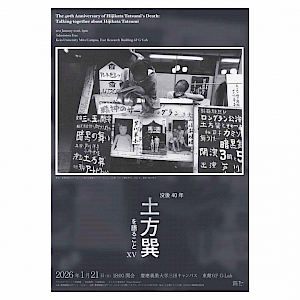
*This event has ended, but we are still streaming the recording on YouTube. Please click here to view the video.
To commemorate the 40th anniversary of Tatsumi Hijikata’s passing, we will be holding Talking Together about Hijikata Tatsumi XV on January 21, 2026.
Throughout 2025, various events related to Tatsumi Hijikata and Butoh took place, leading to his works being widely introduced to international audiences in Hong Kong, Poland, Mexico, and other countries.
Likewise, we have also witnessed many long-time colleagues of Tatsumi Hijikata move on to join him in the next world. Rest in peace, Yasunao Tone, Nario Gōda, Masatoshi Naitō, and Koichi Tamano.
Yasunao Tone was a composer in the Avant-Garde movement who collaborated with Tatsumi Hijikata starting in the 1960s. Nario Gōda, a Butoh critic, followed Hijikata’s activities closely ever since his 1959 performance of Forbidden Colors. Koichi Tamano was very possibly Tatsumi Hijikata’s first pupil, becoming a Butoh performer after knocking on the doors of Asbestos Studio in the mid-1960s.
Now, we turn to the new year, speaking about Tatsumi Hijikata and his legacy, even amidst the loss of these inspirational figures who shared such deep connections with him.
It was exactly fifty years ago, in 1976, when Asbestos Studio welcomed crowds of audience members into Theatre Asbestos for a series of Hakutobo performances. This culminated in Tatsumi Hijikata announcing that they would have to cut off admission at 1,500 people. It’s been half a century, and the progress of Butoh since then has been staggering.
The guest speaker for the 40th-year commemoration is Saga Kobayashi. Saga Kobayashi joined Asbestos Studio in 1969. These days, there are fewer and fewer people who knew what she was like back as a member of Genjusha (the Fantastical Animal Company). However, for those few dedicated fans, I am sure that her performance during Watashi no Musume(lit. “My Daughter”) in Kabukicho dances on, phantomlike, in their memories.
While she has clearly grown out of the “daughter” archetype, Saga Kobayashi remains one of Japan’s leading Butoh performers, traveling abroad to teach the ways of Tatsumi Hijikata while dancing in forms authentic to herself.
We look forward to hearing Saga Kobayashi’s inexhaustible stories about her teacher Tatsumi Hijikata, her comrade Koichi Tamano, and about herself as she reflects now on a career spanning the turn of the century.
(Written by Takashi Morishita)
*Please note that the format and content of the event may be subject to last minute changes. We recommend checking the Keio University Art Center’s website before the event for the most recent information.
★Flyer:Download
Date
Wednesday, 21st January 2026 18:00 start (doors open 17:00)
Venue
6F, Global Research Lab (G-Lab), East Research Building, Mita Campus, Keio University (“13” on the campus map)
Audience
Open to everyone / Visitors are welcome to enter and leave the venue at any time
Event will be streamed online (via Zoom Webinar)
Cost
Admission Free
Enquiries and bookings
Ms. Ishimoto, Keio University Art Center Tatsumi Hijikata Archive
Tel: 03-5427-1621 Email: pj.ca.oiek.c-tra@otomihsi
Discussion[Talking together about Tatsumi Hijikata]
Date
Wednesday, 21st January 2026 18:00 start (doors open 17:00)
Venue
6F, Global Research Lab (G-Lab), East Research Building, Mita Campus, Keio University (“13” on the campus map)
Audience
Open to everyone / Visitors are welcome to enter and leave the venue at any time
Event will be streamed online (via Zoom Webinar)
Cost
Admission Free
Booking
No booking required
Lecturer/Performer
Guest speaker: Saga Kobayashi
Saga Kobayashi
Saga Kobayashi first encountered Tatsumi Hijikata’s Butoh performances in 1968, joining the “Tatsumi Hijikata Hangi-Daitōkan” the next year. She performed in multiple Tatsumi Hijikata productions, including Twenty-Seven Nights for Four Seasons at Art Theatre Shinjuku Bunka, Quiet House at the Seibu Theater in Tokyo, and Summer Storm at the Seibu-Kodo Hall of Kyoto University. In 1975, she went independent and formed a company with Ryuichi Tachibana called the Suisei Kurabu (lit. “Comet Club”). Then, in 1985, she formed Saga Kobayashi + Nosuri, putting on the “Aura Series” that dove into the world of the unconscious, such as Tsukihime (Gekki): Muishiki no Hana (lit. “Moon Princess: the Unconscious Flower”) at Theatre Tram. Since 2019 she has returned to the roots of Butoh through solo and group performances as a part of the “Untitled Series,” exploring new perspectives and possibilities for the future of the artform. She has also been active abroad in Europe and other countries. In 1980, she participated in the Japan Festival and performed Hijikata’s Nihon no Chibusa (lit. “Breasts of Japan”) alongside Yoko Ashikawa in six different countries in Europe.
In 2024, Saga Kobayashi performed Gen no Ji no Kodomo (lit. “Children of the Phantom Letters”) at Studio Terpsichore, which received an award from the Dance Critics Society of Japan. That same year, a screening, workshop, and performance of her 1977 solo rendition of Nigai Hikari (lit. “Bitter Light”) was held at Yale University.
Publications: Ume no Sunakusa — Words of Butoh, Publisher: Atelier Third
Timetable
“Talking Together about Hijikata Tatsumi”
17:00 - Venue opens
18:00 - Event begins
Discussion about Tatsumi Hijikata and Butoh (Moderator: Takashi Morishita)
19:00 - Presentation by guest speaker
20:00 - Event ends
Enquiries and bookings
Ms. Ishimoto, Keio University Art Center Tatsumi Hijikata Archive
Tel: 03-5427-1621 Email: pj.ca.oiek.c-tra@otomihsi
Organiser(s)
Host: Keio University Art Center (KUAC)
Organizer: Keio University Art Center Tatsumi Hijikata Archive, Portfolio Butoh
Cooperation: Tatsumi Hijikata Asbestos Hall, Butoh Laboratory, Japan
This project is supported by the FY2025 Grant-in-Aid for Scientific Research(c) for "Movement Archive-International Cooperation of Creative Use of Archives(25K03758)."
Online (Zoom Webinar)
Please follow the link below to participate.
Liink: https://keio-univ.zoom.us/j/86074045575?pwd=U7dMJVdGAb3R6wvCabTn98okJe8ZhV.1
ID: 860 7404 5575

KeMCo New Year Exhibition 2026 Where the Horses Are
The 2026 KeMCo New Year Exhibition, Where the Horses Are, will also be open to the public that day on the third floor of the Keio Museum Commons’ East Annex on Mita Campus. Stage photographs from the Paragon of Sacrificing Great Dance, Performance to Commemorate the Second Unity of the School of Dance of Utter Darkness: Twenty-seven Nights for Four Seasons “Gibasan” will be featured along with other artifacts and materials. We hope that you will take the time to stop by.
What's on
- Keio University Mita Campus Architecture Open Day
- Introduction to Art Archive XXIX: Yoshio Taniguchi in Keio
- [Nishiwaki Junzaburo Seminar : Public event] The Humorous Nature of Nishiwaki's Poetry —The Freshness of the Nishiwaki Image Captured by Kiwao Nomura and the Charm of His Words
- Kasai Akira Post Butoh Performance “Dancing Beethoven The Piano Sonata No. 32 in C minor, Op. 111”